The Big Versus: Machine Translation vs LLM
The Big Versus: Machine Translation vs AI
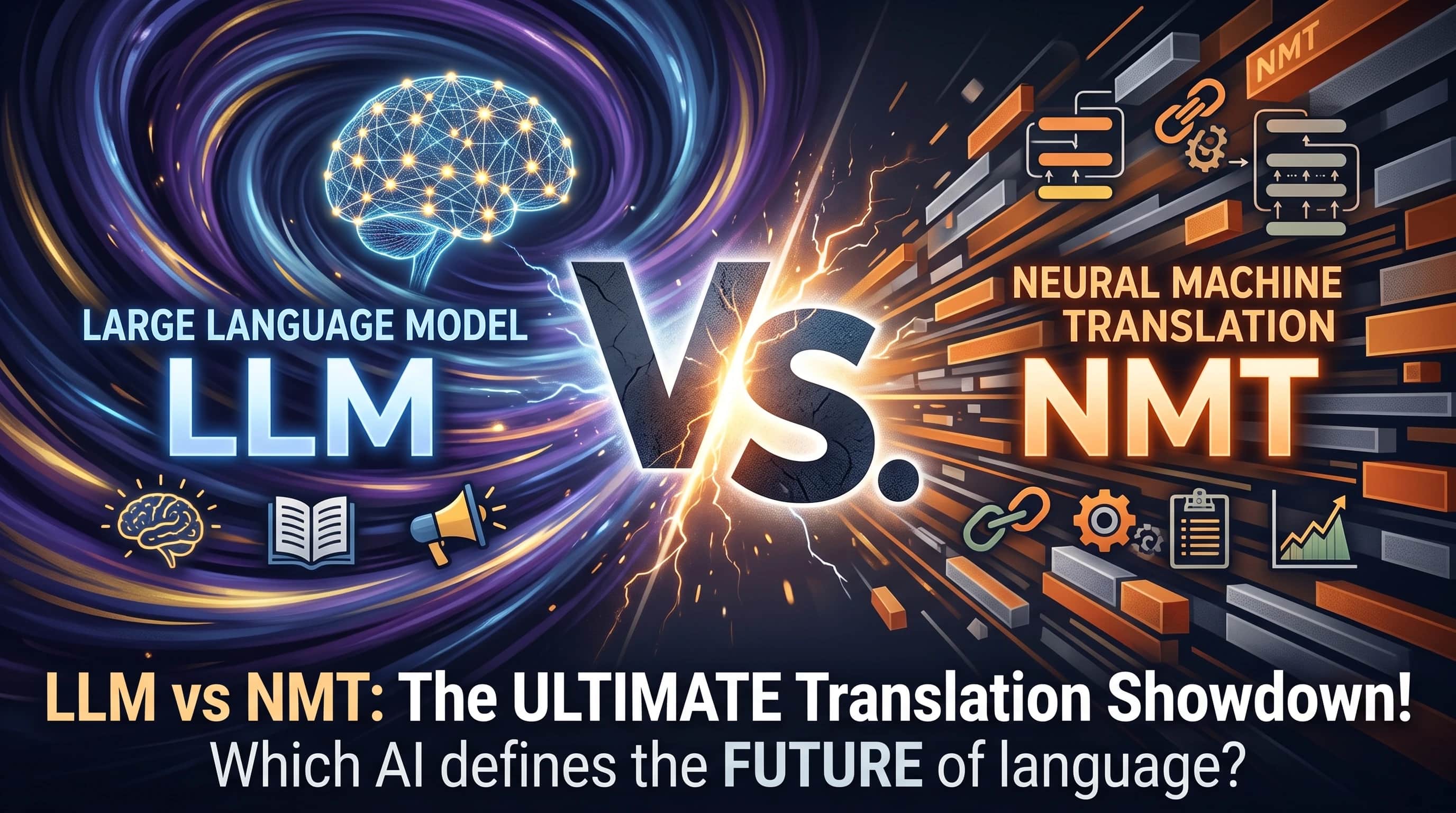
Every single day, billions of lines of text quietly pass through translation systems — from the tabs open in our browsers to the apps on our phones, from e-commerce product descriptions to the subtitles on our favorite shows. They're everywhere, working in the background. But here's the thing: when we say "a machine translated this," who's actually doing the heavy lifting? Is it the Neural Machine Translation (NMT) engines built specifically for this one job, or the general-purpose generative AI (LLM) models that can also write poetry, debug code, and draft emails? In this post, we're putting NMT and modern AI translation head-to-head, from their origins to how they actually work.

A simple artificial neural network: input layer, hidden layers, and output layer — the building block of NMT. (Image: Glosser.ca, Wikimedia Commons, CC BY-SA 3.0)
1) Machine Translation: A Brief History from the 1950s to Today
The roots of machine translation go surprisingly deep — some sources trace them all the way back to the 9th-century Arab cryptographer Al-Kindi. But the modern research era really kicked off in the 1950s. The big moment came in 1954, when the famous Georgetown–IBM experiment publicly demonstrated that a computer could translate Russian sentences into English. It was a revelation.
From rule-based systems to statistical methods (SMT), the field has come a long way. Today, that torch has largely been passed to neural machine translation and large language models. The symbolic turning point? 2016. Google Translate, which launched back in 2006 as a statistical service, switched over to its GNMT system that year and claimed to cut translation errors by roughly 60% for certain language pairs. That was the moment machine translation stopped feeling like a word-by-word puzzle and started sounding like actual language.
2) What Is NMT?
Neural machine translation (NMT), at its core, is an approach that uses artificial neural networks to predict the likelihood of word sequences — typically modeling entire sentences in one integrated model, rather than chopping them into fragments. Here's how it works in plain terms: an encoder reads and compresses the source sentence, and a decoder writes out the translation, word by word. Along the way, the attention mechanism helps the model figure out which part of the source sentence to focus on at each step. Then came 2017, and with it, the Transformer architecture — which made the whole thing dramatically faster and more powerful.
This architecture quickly became the backbone of the industry: Baidu rolled out the first large-scale NMT system in 2015, followed by Google's GNMT in 2016. These days, for "high-resource" language pairs — the ones with plenty of training data available — NMT can produce translations that, under the right conditions, come remarkably close to human-level quality.

The Transformer architecture: encoder–decoder structure with attention. This design is the common ancestor of both modern NMT and today's LLMs (GPT, etc.). (Image: dvgodoy, Wikimedia Commons, CC BY 4.0)
3) So What Is "AI Translation" (LLM)?
Now we get to the heart of the title question. Large language models like GPT aren't really "translation engines" at all — they're general-purpose text models. They can write essays, summarize long documents, analyze sentiment, and yes, translate too. And unlike NMT, you don't need to train them on massive parallel corpora; you can just prompt them with something like "translate this text" and watch them go.
It's a promising approach, no doubt. But it's also far more resource-intensive than using a purpose-built translation model. On the upside, LLMs really shine where NMT tends to struggle: understanding context, adapting tone and style, and navigating cultural nuance. On the downside? The cost per word can be 5 to 50 times higher than NMT, and studies still show that for several language pairs, human translators beat ChatGPT when it comes to terminological accuracy.
4) NMT vs LLM: Quick Comparison
Let's cut to the chase and put them side by side:
| Criterion | NMT (Specialized Engine) | LLM (Generative AI) |
|---|---|---|
| Training | Parallel (source–target) corpora, single task | Massive general text, multi-task |
| Speed & Cost | Fast and cheap; great for volume | Slower and pricier (5–50×) |
| Terminology / Consistency | High, predictable | Variable; needs prompt engineering |
| Context & Style | Limited; tends toward literal translation | Strong; adapts tone and style |
| Low-resource languages | Weak (data-dependent) | Flexible, but hallucination risk |
| Ideal use cases | E-commerce, support, subtitles, real-time | Marketing, literary content, creative adaptation |
5) Conclusion: The Answer to "MT or AI?"
Here's the truth: they're not really rivals — they're more like relatives. The very Transformer architecture that powers today's LLMs was born inside the NMT research community. And the claim of "human parity" in translation? Still contested on both sides — even the best NMT outputs (think DeepL) usually need a human editor to give them a final polish. In practice, the winning formula is almost always hybrid: NMT for volume and speed, LLMs for style and nuance, and a human in the loop for quality assurance.
So what's the verdict? "Machine Translation or AI?" — the honest answer is it depends. NMT when you need scale, AI when you need nuance, and a human for the final word. ✍️
References
- Wikipedia – Neural machine translation. https://en.wikipedia.org/wiki/Neural_machine_translation
- Wikipedia – Machine translation. https://en.wikipedia.org/wiki/Machine_translation
- Wikipedia – Google Neural Machine Translation. https://en.wikipedia.org/wiki/Google_Neural_Machine_Translation
- Wikipedia – History of machine translation. https://en.wikipedia.org/wiki/History_of_machine_translation
- Wikipedia – Google Translate. https://en.wikipedia.org/wiki/Google_Translate
- Dokutech – LLM vs NMT: an in-depth analysis of machine translation models. https://dokutechtranslations.com/en/llm-vs-nmt-an-in-depth-analysis-of-machine-translation-models/
- Pangeanic – Which is better for my use case: (neural) NMT or LLM translation? https://blog.pangeanic.com/which-is-better-for-my-use-case-nmt-neural-mt-or-llm-translation
- GALA Global – NMT vs. LLM: Who Really Wins at Translation? https://resources.gala-global.org/machine-translation-large-language-model/
- Wu et al. (2016) – Google's Neural Machine Translation System: Bridging the Gap between Human and Machine Translation. arXiv. https://arxiv.org/abs/1609.08144
- Wired (2016) – An Infusion of AI Makes Google Translate More Powerful Than Ever. https://www.wired.com/2016/09/google-claims-ai-breakthrough-machine-translation/
- Wikipedia – Transformer (deep learning). https://en.wikipedia.org/wiki/Transformer_(deep_learning)
- Wikipedia – Large language model. https://en.wikipedia.org/wiki/Large_language_model